December 30, 2023

Completed 40m ARRL DXCC Award

A big THANK YOU to Leong (XX9ET) in Macao for being my 100th DXCC contact confirmed on LoTW on 30 meters.  Thank you also for being my first contact with Macao.  I look forward to our next contact further on down the log.

Macao is a city and a special administrative region of China in the western Pearl River Delta by the South China Sea.  Macao is 60 km (37 mi) west of Hong Kong.

Flag of Macao

I am delighted to have earned the ARRL 40 meters DXCC award. It took many years to complete.  All contacts were made with 100 watts or less and using simple wire antennas.

As I write this, I have now completed DXCC on six bands: 10 Meters, 15 Meters, 17 Meters, 20 Meters, 30 Meters, and 40 Meters. I am presently working on achieving DXCC on two remaining bands.
  • 12 Meters - 85 qualifying contacts confirmed on LoTW
  • 80 Meters - 46 qualifying contact confirmed on LoTW
  • 160 Meters - No antenna
I am also pursuing the DXCC Challenge Award which requires confirming at least 1,000 DXCC band-points on any Amateur bands, 160 through 6 meters (except 60 meters). I presently have 825 contacts confirmed on LoTW toward the DXCC Challenge Award.


Good DX and 73, NJ2X

December 29, 2023

Completed 12m WAS from Santa Cruz County, CA

A big THANK YOU to Kevin (KF0IPD) for confirming my 50th State contact on 12 Meters needed to complete ARRL 12m WAS mixed and digital awards.  Kevin, I look forward to our next contact further on down the log.

Colorado State Flag


From my QTH in Santa Cruz County, California, I have completed WAS on 80m, 40m, 30m, 20m, 17m, 15m, and 10m.  I have confirmed 22 State contacts on 6m; though, I am not really pursuing the award.  I have completed 47 state contacts using the FT4 mode.  Just need Montana, New Mexico, and Wyoming.

Good DX and 73, NJ2X

December 22, 2023

Digital QSL Card from W5AAI - December 22, 2023

I received this serene QSL card from Marvin (W5AAI) in Pryor, OK for our December 22, 2023 40m FT8 contact.  Thank you Marvin.  I look forward to working you again further on down the log.


Good DX and 73, NJ2X

Digital QSL card from W1WRA - December 22, 2023

I received this excellent digital QSL card today from Bill (W1WRA) for our December 22, 2023 10m FT4 contact.  Thank you Bill for the contact and card.  Look forward to working you again in the future.


Good DX and 73, NJ2X

December 21, 2023

Digital QSL Card from N8CWU for December 21, 2023 10m FT4 contact

I received a wonderful digital QSL card today from Larry (N8CWU) for our December 21, 2023 10m FT4 contact.  I was delighted to see the setting of this photograph as it immediately brought back fond memories of visiting the Cape Hatteras Lighthouse.  Thank you Larry.  I look forward to our next contact further on down the log.

Digital QSL card from Larry (N8CWU) for a 10/21/2023 10m FT4 contact


Good DX and 73, NJ2X

December 14, 2023

Digital QSL Card from W1AL - November 13, 2023

I really like the digital QSL card that Scott (W1AL) sent me for our November 13, 2023 10m contact via FT4.  It is beautifully designed.  Thank you, Scott.  I look forward to our next contact further on down the log.

W1AL Digital QSL Card - November 13, 2023 10m FT4 Contact with NJ2X


Good DX and 73, NJ2X

December 10, 2023

Digital QSO Card from KA1MXL - December 10, 2023

I received this beautiful digital QSL card from Kevin (KA1MXL) in Warwick, Rhode Island (Kent County) for our 10 Meters contact on December 10, 2023 via FT4.  Thank you, Kevin, for the contact and QSL card.  I look forward to our next contact.


Good DX and 73, NJ2X

December 5, 2023

800th confirmed DXCC Challenge Award contact

A big THANK YOU to Derek (ZD7CTO) on Saint Helena Island for being my 800th confirmed contact toward the ARRL DXCC Challenge Award.  This was also my first contact with Saint Helena Island which made it doubly exciting.

Flag of Saint Helena Island

Saint Helena Island is a remote volcanic tropical island 1,950 km (1,210 mi) west of the coast of south-western Africa, and 4,000 km (2,500 mi) east of Rio de Janeiro in South America. It is one of three constituent parts of the British Overseas Territory of Saint Helena, Ascension, and Tristan da Cunha.

80% there with only 200 more contacts to go to complete the ARRL DXCC Challenge Award.  The award now seems within reach and achievable instead of distant and theoretical.  There are still many DX locations that are relatively easy to reach representing holes on various bands to fill.  For example, I need Vietnam on 17m.  The easy to fill holes probably don't add up to 200 contacts though.  That means I need to work the hard-to-reach stations which for me are in Africa and the Middle East.

I have an opportunity to add a good number of new DX contacts by working more on the 12 Meters band.  The band is performing really well with the return of sunspots, and it has traditionally been one of the bands I am least active on.  I now have a 12 Meters half-wave end-fed vertical antenna that I can tune up.

I only need to confirm two more contacts on LoTW to complete 40 Meters DXCC.  I have a bunch of unconfirmed DX expedition contacts that will eventually be confirmed on LoTW.  In the meantime, I continue hunting for additional 40m DX contacts who use the LoTW.

I have made several DX contacts recently with stations that don't confirm contacts via the Logbook of the World (LoTW).  I remain hopeful that these radio amateurs will eventually see the light and join in the LoTW and upload our contacts.  From time-to-time, this does happen.

Good DX and 73, NJ2X


December 2, 2023

Astron RS-35M Back in Action

In my prior post (Astron RS-35M RIP), I shared how my 16-year-old workhorse linear power supply failed and my intent to bring it back to life by repairing it myself.  I studied basic electronics in college and have completed many electronic projects over the years, so I felt confident that repairing the power supply was within my capability.  I also enjoy a good challenge, keeping electronic gear out of landfills, and saving money.  I saw no reason to buy a brand-new linear power supply.

Dead Astron RS-35M Power Supply

What is a linear power supply?

The main purpose of a power supply is to convert electric current from a source to the correct voltage, current, and frequency to the load. 

A linear power supply provides regulated output voltage (in this case 13.8VDC) to power an electrical load (amateur radio equipment in this case) without the use of switching or digital components.  A key component of linear power supplies are large transformers.

A linear power supply has many outstanding characteristics as compared to switching power supplies including low noise, low ripple, simplicity, robustness, and ease of repair. This comes at a cost of being relatively heavy, large in size, and requiring heatsinking.  Linear power supplies are generally preferred by hams for amateur radio applications.

Diagnosis

Over the years, the linear power supply had slowly acquired a noticeable hum.  The 60-Hz hum seemed to have grown more loudly in the last year or two.  Hum in a linear power supply can be an indication of bridge rectifier and filter capacitor degradation.  Electrolytic filter capacitors are notorious for breaking down with time.  The power supply's original filter capacitor was 16 years old and possibly in need of replacement.  My hypothesis was that the power supply blew its fuse at power-on due to a bridge rectifier with a dead-short and this may have also taken out the electrolytic filter capacitor.

To verify my hypothesis, I started by unplugging the power supply from house power and the attached equipment and put it on the bench.  The first step was to remove the chassis cover.  This was accomplished by removing three screws on the top of the case cover and four screws on the bottom and then sliding off the cover.

The next step was to discharge the electrolytic filter capacitor.  This is an important safety step as the filter capacitor is physically large and can store potentially dangerous electrical energy.  To discharge the capacitor, I placed a power resister across the filter capacitor terminals in place.  I then confirmed the capacitor was fully discharged with my voltage meter.

I then loosened the screw on the bracket that holds the capacitor in place.  I also removed the positive and negative terminal screws from the filter capacitor.  This permitted the filter capacitor to be removed from the power supply.  I placed the discharge resister across the capacitor terminals again as a safety precaution.

The next step was to remove the bridge rectifier gang from the power supply.  I decided the easiest way to remove the bridge rectifier was to simply snip the two AC (yellow) and the positive DC (red) leads and then unbolt the bridge rectifier gang assembly from the chassis.

Original Diotec DB2501 dual bridge rectifier gang 

Once the bridge rectifier gang assembly was out of the chassis, I used my multimeter's diode test feature to check the bridge rectifier gang.  The test showed that indeed the rectifier had a dead short (between positive DC and one of the AC terminals in both directions) and needed to be replaced.  It is likely that only one of the rectifiers had a dead short.  I decided to replace both DB2501 rectifiers as the cost is low and not really worth trying to salvage one rectifier.  It is also important to match the two rectifiers, so they work together.

Original DB2501 bridge rectifier assembly testing found a dead short

I checked various RS-35M schematics, and they indicated that the correct bridge rectifier was supposed to be a pair of DB3501.  For some unexplained reason, my particular RS-35M power supply had a pair of DB2501 bridge rectifiers installed.  A pair of DB2501 rectifiers would have to work much harder and thus not last as long as a pair of DB3501.  Having the incorrect underrated components was likely a root cause issue.

Original (undersized) DB2501 removed from the Astron RS-35M


Replacement Parts

I bought the replacement parts directly from Astron rather than risk getting it wrong with other sources.  Buying from Astron made it very easy to purchase parts that were both electronically and mechanically suitable.

I decided to simply replace the original electrolytic filter capacitor rather than try to determine if it was still serviceable.  This was an easy decision.

Replacement Electrolytic Filter Capacitor (25 VDC, 100,000 µF)

For the bridge rectifiers, I could have replaced the original Diotec DB2501 (100V, 25A) rectifiers with the same or returned to the specified DB3501 (100V, 35A).  However, for a nominal additional cost, I found I could replace the original DB2501 rectifiers with two heavier duty DB5001 (100V, 50A) components.  This seemed like a good choice.

Replacement DB5001 bridge rectifiers

To reconstruct the rectifier gang assembly, I upgraded the wire to 10 gauge.  The heavier gauge wire would more easily handle the electrical power while also providing a little more heat dissipation.

10-gauge wire ready for assembling the bridge rectifier gang

The bridge rectifiers are mounted directly to the power supply chassis.  The metal chassis acts as a heatsink for the rectifiers.  When I removed the original rectifiers, I noticed that they were installed with white heat sink compound.  For the repair, I used GC Electronics Type Z9 silicone heat sink compound.

Type Z9 Heat Sink Compound

I replaced the linear power supply's fuse with the same standard AGC-8A fuse.

Original AGC-A8 blown fuse (left) and new replacement AGC-8A fuse (right)


Repair

Step 1: Assemble the bridge rectifier gang.
The DB5001 bridge rectifier connector pins need to be twisted 90 degrees so that the connector holes line up.  I used a pair of needle nose pliers to gently twist the connectors.

Next, I oriented the DB5001 bridge rectifiers, so they matched the original DB2501 orientation.


Original DB2501 bridge rectifier assembly

I then placed the three 10-gauge wires through the connector holes AC to AC, positive DC to positive DC, and AC to AC.

Old DB2501 bridge rectifier assembly with oriented DB5001 rectifiers and 10-guage wires

Next, I used original DB2501 bridge rectifier gang assembly as a jig for the next DB5001 assembly.  I pinned the two assemblies together by placing a hex key and a punch through the center holes.  This made it easy to solder the connectors and wires while maintaining the proper orientation and hole spacing.  Correct hole spacing is necessary to install the assembly in the chassis.


The next step was to solder the 10-gauge wires.  I used a dab of electrical solder flux to prep the wires and connectors for soldering.  Flux cleans the metal surface which helps the solder to flow.  After soldering the wires and connectors, I also tinned the middle section of each of the three 10-gauge wires.  Having tinned wires helps when soldering the power leads.

The next step was to solder the two AC input transformer leads (yellow) and the DC positive output lead (red).  I removed a small length of the plastic insulation from each wire.  I then wrapped the 10-gauge solid wire with a lead wire and soldered it.  The heavy gauge of these wires required me to turn up my soldering iron temperature to high (750F) to properly flow the solder throughout the connection.


Step 2: Prep the chassis for installation of the bridge rectifier gang assembly.
I carefully removed all traces of the original white heat sink compound from the chassis using a paper towel and wiped down the chassis interior to remove dust and debris that had accumulated over the years.  It is important to have a clean chassis surface free of debris.  I then applied a liberal coat of the fresh white heat sink compound to bottom surface of each of the DB5001 bridge rectifiers.

Step 3: Install the bridge rectifier gang assembly.
I placed the chassis on its side to make it easy to position the bridge rectifier gang assembly while simultaneously pushing the rectifier screws through the bottom chassis holes.  I used a 1/4" drive 9/32" deep well socket to hold the nut while using a short-handle Philips head screwdriver to tighten the rectifier screw.  The space is a little tight, so this technique made it easy. After tightening the screws and nuts holding the rectifiers to the chassis, I used a paper towel to wipe up the excess white heat sink compound that was squeezed out.

Short handle Philips screwdriver and a 9/32" deep well socket

Step 4: Install the replacement electrolytic filter capacitor.
I first discharged the new replacement filter capacitor with a resistor to make sure the capacitor was safe to handle.  I then mounted the new replacement filter capacitor in its bracket making sure the capacitor polarity was oriented the same as the polarity as indicated on the circuit board.   I then tightened the negative (black) and positive (red) wires to the circuit board and capacitor.  I then tightened the capacitor bracket so that the assembly was secure to the chassis.


New replacement electrolytic filter capacitor installed.

Step 5: Replace the AGC-8A fuse.
I removed the old burnt out AGC-8A fuse and replaced it with a new AGC-8A fuse.  

Step 6: Test the power supply and measure the voltage output.
I connected my multimeter to the power supply's output terminals.  I plugged in the power supply and turned it on using the switch on the front of the chassis.  To my delight, the volage output measured at 13.74 volts.  The power supply was working again!


Power supply output voltage test (no load)

Step 7: Install the power supply chassis cover.
I turned off the power supply and then disconnected the AC power input.  I then placed a resistor across the filter capacitor terminals to discharge the capacitor as a safety measure.  Then placed the power supply on its side and carefully slid the cover onto the chassis.  Once in position, I screwed in three screws on the top and four screws on the bottom. 

Step 8: Test the power supply with a load (radio).
I returned the power supply to its operating position and reconnected my main radio.  I powered up the power supply and then the radio.  The voltage was consistent with minimal load (receive only) and with a full load (transmit).  It was wonderful to hear the power supply function silently both idle and under load.  The hum is gone!

Repaired Astron RS-35M power supply under load


Conclusion

Repairing my Astron RS-35M was a very satisfying project.  The process was thoroughly enjoyable - figuring out what to do, ordering parts, performing the repair with the sweet smell of solder smoke, and testing to find the issue and repair outcome.  The repair cost about $40 for replacement parts and $13 for a tube of heat sink compound (with 99.9% of the tube left over).  The repair represents value as compared to buying a brand-new power supply.

I am delighted to be back on the air and making contacts again with a nice silent power supply.  A big thank you to Astron for making such a great power supply.  My Astron RS-35M has been an outstanding performer for many years.  I appreciate its design, years of reliable service, and serviceability.  In spite of Astron originally installing the incorrect and underpowered DB2501 rectifiers 16 years ago, I plan to stick with Astron for all my future power supply needs and I would recommend Astron to my fellow hams should anyone ask.

Have you repaired an Astron power supply before?  How do it go?  Would love to hear from you.  Please leave a comment.

For those who appreciate a bit of electronics trivia, Astron designates standard desktop power supplies with the "RS-" prefix meaning Regulated Supply.  The "M" suffix denotes power supplies with front panel Meters.

Good DX and 73, NJ2X


December 3, 2023 Update
I discovered today that the original failure also caused both meter lamps to burn out.  I didn't catch this at first due to working with the linear power supply on a well-lit bench.  The meters seem to also be registering a little higher voltage and current values than before the failure which may be due to the absence of the load from the incandescent lamps.  I am considering replacing the lamps with LEDs as a future project.  For now, the meters are perfectly readable in their usual operating position.


November 24, 2023

Astron RS-35M RIP

I have been using an Astron RS-35M linear power supply in the shack since I first became a ham in 2007.  It has performed flawlessly year after year providing a consistent 13.8 volts to my radio gear.  Over time, it acquired a bit of hum but otherwise performed as it should.  Hum in a power supply can be an indication of the gradual deterioration of the supply's filter capacitor and bridge rectifier components.

Yesterday (November 23, 2023), my well used and well appreciated RS-35M immediately blew its AGC 8A fuse (with a noticeable thud) when I attempted to power it on in the morning.

Internal view of the Astron RS-35M Power Supply

I decided to use this power supply failure as opportunity to replace the original bridge rectifiers and the original filter capacitor (25v 64000 µF electrolytic).  These parts tend to degrade with time and use.  I also decided to upgrade the DB2501 (25 Amp) bridge rectifiers to DB5001 (50 Amp) since the cost difference was only $1.50 each.  The higher power DB5001 will work a little less hard to do the job.

Astron RS-35M Power Supply

I bought the replacement parts on Astron's website https://www.astroncorp.com/ at reasonable prices.  I am looking forward to receiving the parts, completing the repair, and getting back on the air soon. Stay tuned for a future article about the repair process.

Rest in peace Astron RS-35M (during this short hiatus).  You will be repaired in couple of days and back on duty supplying clean power.

Good DX and 73, NJ2X


Related articles on NJ2X.com:


November 18, 2023

USAF MARS Certificate 75 Years November 2023

I was delighted to receive a nice surprise today from the United States Air Force Military Auxiliary Radio System (MARS) for making a contact with W1A during their 75th year special event held November 5 - 11, 2023.  I really like the certificate confirming our contact.


Good DX and 73, NJ2X

October 29, 2023

Digital QSL Card from W6BSD on October 29, 2023

Thank you, Ken (W6BSD), for the beautiful digital QSL card.  Hope to work you again in the future.


Good DX and 73, NJ2X

October 20, 2023

Yupiteru MVT-7100

Many moons ago, I had the pleasure of owning a 1990's vintage Yupiteru MVT-7100 scanner.  It was a really great little handheld radio.  It had wide band reception and 1000 memories (10 banks) that could be scanned at 30 channels per second.   The sensitivity was excellent (better than 1 µV on most ranges).  The superheterodyne receiver was capable of continuous tuning from 0.53-1650 MHz (tunes down to 0.1 kHz) and supported AM, FM, W-FM, CW, and SSB modulation.  Amazing!  

Yupiteru MVT-7100 multiband receiver


It covered all the ham bands including: 160m, 80m, 60m, 40m, 30m (WARC), 20m, 17m (WARC), 15m, 12m (WARC), 6m, 2m, 1.25m, 70cm, 33cm, 23cm, 10m, and 4m.  It also covered the 11m (CB) band.

Tuning steps were configurable: 0.05 / 0.1 / 1 / 5 / 6.25 / 9 / 10 / 12.5 / 20 / 25 / 50 / 100 kHz.

As was the case with all the other handheld scanners of this vintage, the radio could only be programmed manually (not via computer).  This could be tedious with 1000 memories.  However, programming was part of the fun and charm of the radio.

The antenna was connected via a robust BNC connector.  On an aside, I still prefer the BNC connector to the modern SMA connector.  The BNC connectors are stronger and more durable.  I have seen several SMA's fail while BNCs continue to work without failure with decades of hard use.  I am not convinced the more fragile and shorter life SMA connectors have been good for handheld radio gear.  What are your thoughts?

The Yupiteru was a versatile and fun radio to play with.  It is considered by many as one of the best general coverage handheld scanners ever made.

Good DX and 73, NJ2X


October 13, 2023

Arizona QSO Party 2023

The Arizona QSO Party 2023 is being held 1500z Oct 14 to 0500z Oct 15, 2023 (UTC).  I plan on hunting Greenlee County which is the last AZ County that I need to complete contacts with all counties in the state.  If you happen to know the frequency a Greenlee County ham is calling, please let me know.

Join the party.   Make some contacts.   Have ham radio fun!

For more information to go: AZQP - Arizona QSO Party

Arizona State Flag


Good DX and 73, NJ2X

October 6, 2023

Completed 30m ARRL DXCC Award

A big thank you to Vasily (YL3AKH) in Latvia for being my 100th DXCC contact confirmed on LoTW on 30 meters.  Latvia is a country in the Baltic region of Northern Europe. Its capital and largest city is Riga.  Latvians belong to the ethnolinguistic group of the Balts and speak Latvian.  Around 3000 BC, the proto-Baltic ancestors of the Latvian people settled on the eastern coast of the Baltic Sea.

I am delighted to have earned the ARRL 30 meters DXCC award. It took many years to earn this award.  All contacts were made with 100 watts or less and using simple wire antennas.

Flag of Latvia


As I write this, I have now completed DXCC on 10 Meters, 15 Meters, 17 Meters, 20 Meters, and 30 Meters. I am working on achieving DXCC on several bands.
  • 12 Meters - I now have an antenna and progressing (69 qualifying contacts confirmed on LoTW).
  • 40 Meters - Making good progress (93 qualifying contacts confirmed on LoTW)
  • 80 Meters - Slow progress (40 qualifying contact confirmed on LoTW)
  • 160 Meters - No antenna.
I am also pursuing the DXCC Challenge Award which requires confirming at least 1,000 DXCC band-points on any Amateur bands, 160 through 6 meters (except 60 meters). I presently have 769 contacts confirmed on LoTW toward the DXCC Challenge Award.

Good DX and 73, NJ2X


October 5, 2023

2023 California QSO Party Time!

California State Flag


The 2023 California QSO Party will be held:

1600 UTC October 7, 2023 to 2200 UTC October 8, 2023

Radio sport means competition, fun, and hamming it up on the radio.

I am a County hunter, and I will be looking to make contacts with the following California Counties to complete my full set of LoTW confirmed contacts:
  • Alpine County
  • Glenn County
  • Mariposa County
  • Sierra County
If you are operating from one of these Counties, please do let me know so we can set up a schedule.

Good DX and 73, NJ2X


September 29, 2023

Surprising History and Physics of the AC Transformer

This is a fascinating and information video, Surprising History & Physics of the AC Transformer by the wonderful Kathy Loves Physics & History youtube channel.


DX and 73, NJ2X

September 24, 2023

August 13, 2023 World's Largest Teapot Special Event Certificate (W2T)

I received a really fun electronic certificate for working W2T on August 13, 2023 for the World's Largest Teapot Special Event Chester, West Virginia.

The World's Largest Teapot Special Event Certificate


Good DX and 73, NJ2X

September 22, 2023

Maine QSO Party 2024

It is time for the Maine QSO Party 2024!  Check out www.ws1sm.com/MEQP.html for all the details.

Contest Period: 1200 UTC Saturday, September 23 to 1200 UTC Sunday, September 24, 2023.


Good DX and 73, NJ2X

September 5, 2023

2000 US Counties Confirmed on QRZ.com

A big THANK YOU to Jay (K4JND) in Webster County, Kentucky for confirming my 2000th United States unique County contact on QRZ.com.

2000 is a major milestone toward completing contacts with all 3007 US Counties (66%).  I have noticed that hunting counties has become more difficult as I approach the goal line.  My Q-rate with new counties has dropped off noticeably since I reached 1900 Counties on May 27, 2023.  Fortunately, the fun is in the hunt and not in the destination.  The more challenging each new US County contact becomes, the more I enjoy it.
  
I have noticed an increase in county contacts that do not use LoTW.  I use LoTW as my primary logbook and contact confirmations.  It is a bit of a disappointment to make contact with a rare-DX US County and then discover that the radio amateur does not use LoTW.  It does help knowing that many hams eventually find their way to LoTW after having operating without it for awhile.  If you are not using LoTW, I highly recommend it.  LoTW adds a new dimension to the hobby and makes it much easier to go after challenging awards.

Interestingly, I have managed to confirm contacts with all the counties of a given state, with four states (8%). It seems to me this can be explained by the unequal distribution of radio amateurs. There will be more people (and hams operating) in counties with metropolitan areas and less in more rural areas.  For example, Greenlee Arizona is my final missing AZ County (named after Mason Greenlee, early prospector).  Greenlee County, AZ shows 39 licensed amateur radio operators on the QRZ.com county search.  Do you live in or operate in Greenlee County, AZ?  If yes, please contact me so we can set up a sked.

Are you a US County hunter?  If yes, how do you find and confirm those rare-DX US Counties?  Please leave a comment below.

Are you a US County hunter in need of Santa Cruz County, California?  If yes, be sure to let me know if you would like to set up a sked.

Onward to 2100!

Good DX and 73, NJ2X


September 4, 2023

Digital QSL Card HP1CDW April 7, 2022

Thank you, Henry (HP1CDW) for the contact with Panama and the beautiful digital QSL card.  Hope to work you again in the future.


Good DX and 73, NJ2X

August 22, 2023

Eight Applications of Diodes in Circuits

Started my day with an excellent 20-minute overview of diodes.  The Electronic Wizard introduces 3 types of diodes with 8 applications. In the video, he builds each application and demonstrates how the diode affects the circuit using an oscilloscope.  This video is highly recommended.


Good DX and 73, NJ2X

August 19, 2023

Digital QSL card from W2CP for a contact on May 23, 2022

A big thank you to Frederick, W2CP, in Union, New Jersey for the May 23, 2022 contact and the nice digital QSL card.  I do miss the beautiful NYC skyline view from good old New Jersey.  Hope to work you again in the future.


Good DX and 73, NJ2X

Digital QSL card from Ersoy (3C3CA) for a February 12, 2023 contact

Thank you to Ersoy, 3C3CA, in Equatorial Guinea-Malabo for the contact and nice digital QSL card.  I hope to work you again in the future.


Good DX and 73, NJ2X

August 18, 2023

Digital QSL Card from Matthew, N9YBK for a contact on August 18, 2023

I received a nice digital QSL card today from Matthew, N9YBK, in Lake Village, Indiana, USA (population 536 in 2023).  Thank you, Matthew I hope to work you again in the future.

N9YBK Digital QSL Card


Good DX and 73, NJ2X

August 15, 2023

Digital QSL Card from LW2EIY for a contact on August 12, 2023

I received a nice digital QSL card today from Pedro, LW2EIY in Cordoba Argentina.  Thank you Pedro.  Hope to work you again in the future.


Good DX and 73, NJ2X

August 6, 2023

Digital QSL Card from Trent, K04ZML for a contact on February 15, 2023

Thank you to Trent, KO4ZML, in Altamont, Tennessee for sending a nice digital QSL card for our 15m contact on February 15, 2023.  Hope to work you again.


Good DX and 73, NJ2X

June 23, 2023

100th Anniversary of the MacMillan Arctic Expedition

Today marks the 100th anniversary of the MacMillan Arctic expedition setting sail from Wiscasset, Maine, on the schooner "Bowdoin".  MacMillan named his vessel "Bowdoin," to honor his alma mater.  MacMillan taught school for a few years before being recruited as an assistant by Admiral Robert E. Peary to sail on a 1908 Arctic expedition.

Onboard the Bowdoin was a complete 200-meter amateur station donated by the Zenith Radio corporation and an amateur radio operator, Donald H. Mix (1TS) provided by the ARRL.

Zenith station aboard the Bowdoin. Left to right are Fred Schnell, Donald H. Mix, Kenneth Warner, M. B. West, and Donald MacMillan

As a member of the seven-man crew, Mix transmitted a weekly five hundred word message to the North American newspaper Alliance.  The expedition was in contact with home until its return in September 1924.

“No polar expedition will attempt to go north again without radio equipment,” predicted Captain MacMillan.


Good DX and 73, NJ2X


June 10, 2023

ARRL June VHF Contest 2023


The 2023 ARRL June VHF Contest is in full swing this weekend with the aid of sunspots.  6m has been great fun with stations heard on FT8 into the Central Coast of California from all over the US and Canada.


Good DX and 73, NJ2X

May 27, 2023

1900 US Counties Confirmed on QRZ.com

A BIG thank you to Richard, N7WFK, located in Canadian County, Oklahoma, for being my 1900th United States County contact confirmed on LoTW and QRZ.com (1900 out of 3,007).


I noticed that it took me much longer to complete the last 100 Counties than it did to go from 1700 to 1800 Counties.  My q-rate for making contacts with new US Counties has noticeably decreased.  All the same, I am undeterred as completing contacts with all 3,007 US Counties is a long-term goal.  One thing that I have learned in life is to enjoy the journey more than the arriving at the destination.

Chasing US Counties is great fun and if you are looking for a new challenge in amateur radio, I encourage you to dive in.  You may be surprised how far you have progressed already.

Good DX and 73, NJ2X

May 26, 2023

Usefulness of Harmonics in Radio Direction Finding

Harmonics are undesired transmissions produced at multiples of the intended transmission frequency. 

Most radio frequency transmitters produce harmonics at relatively low power levels, as compared to the fundamental frequency (also called the first harmonic).  The second harmonic appears at double the frequency of the fundamental.  The third harmonic is at triple the frequency of the fundamental.  For example, if the fundamental transmit frequency is 146.550 MHz then the second harmonic would be at 146.550 * 2 = 293.1 MHz and the third harmonic would be at 146.550 * 3 = 439.65 MHz.  Harmonics are a potential source of radio frequency interference.

In general, in amateur radio transmitter harmonics are undesirable.  However, there is one situation where an amateur radio operating can benefit from harmonics - radio fox hunting.  

A wide-band receiver is useful for radio fox hunting

In a radio fox hunting, the objective is to locate a hidden transmitter.  Hunting with a wide-band receiver allows the radio fox hunter to tune to the hidden transmitted signal's 2nd and 3rd harmonic frequencies as a way of effectively reducing the received signal strength.  This can provide a competitive advantage since a weak received signal at a harmonic is much easier to locate directionally than a strong signal at the fundamental.

This technique works best when you are in close proximity to the fox transmitter.

Good DX and 73, NJ2X

April 8, 2023

700 DXCC Challenge Contacts Confirmed on LoTW

A big THANK YOU To Lee, VE4DXR, in Winnepeg Canada for being my 700th confirmed DX contact on LoTW.  I need to confirm just 300 more DX contacts to earn the DXCC Challenge award.  


Even though Canada is relatively close, I hadn't previously managed to confirm a contact with a Canadian station on 12m since becoming a ham.  This is explained by the fact that my present home brew 80m Sky Loop antenna doesn't tune up on 12m and my previous last contacts on the band were in 2015.  12m was the final HF band that I needed with Canada which makes my contact with Lee, VE4DXR extra special.


The Winter of 2022 produced a barrage of 31 Atmospheric Rivers that inundated the Central Coast of California and brought 80 mile-per-hour winds.  The high winds shredded many limbs on our majestic cypress tree.  I have been using this particular tree as the primary support for my horizontal 80m sky loop antenna.  Innumerable broken limbs piled up on top of each other in several large tangles out-of-reach up in the tree and on top of my antenna.  Once things have settled down for tree specialists, I plan to hire a professional tree climber to remove the debris so I can put my 80m sky loop antenna back on the air.

Fortunately, I recently ordered a monoband 12m half wave end-fed antenna (EFH12) from Radio Wavz to take advantage of high band propagation conditions and to operate once again on the band after a long hiatus.  A vertical half-wave antenna is excellent for DX due to low take-off angle RF radiation pattern.

Once the storms passed, it only took a few minutes to improvise a temporary antenna setup using a bit of 550 cord and a telescopic 15-foot painters' pole.  I used the painters' pole as a support and the rope to provide distance between the antenna and the conductive pole.  I then leaned the pole upright against a tree near the shack to create a 55-degree sloper antenna configuration.  I also added a 24-inch wire terminated with alligator clips to ground the antenna's PL259 connector to the copper water entry point to my shack.  The grounding helped eliminate reflected RF coming into the shack due to using only a short length of coax.

I was impressed with the initial results obtained from this improvised setup when I quickly logged a good number of DX contacts on the 12m band.

  • PU2GHZ - Iuri - Brazil - 6008 miles
  • LU2NI - Carlos - Argentina - 5835 miles
  • HL2IFR - Ryu - Republic of Korea - 5693 miles
  • JF1NZW - Hiro - Japan - 5133 miles
  • E6CI - Leszek - Niue - 4980 miles
  • 5W1SA - Atsuo - Samoa - 4788 miles
  • J68HZ - William - Saint Lucia - 4046 miles
  • HI8VJS - Victor - Dominican Republic - 3382 miles
  • VE4DXR - Lee - Canada - 1517 miles
I am delighted with the results from my initial test of the Radio Wavz EFH12 antenna.  I plan on setting up the antenna in a permanent configuration in a vertical orientation with a longer run of coax.  I expect these improvements will yield even better results.  I look forward to working you on 12 meters soon.

Good DX and 73, NJ2X


March 17, 2023

ClearNode One Year Review

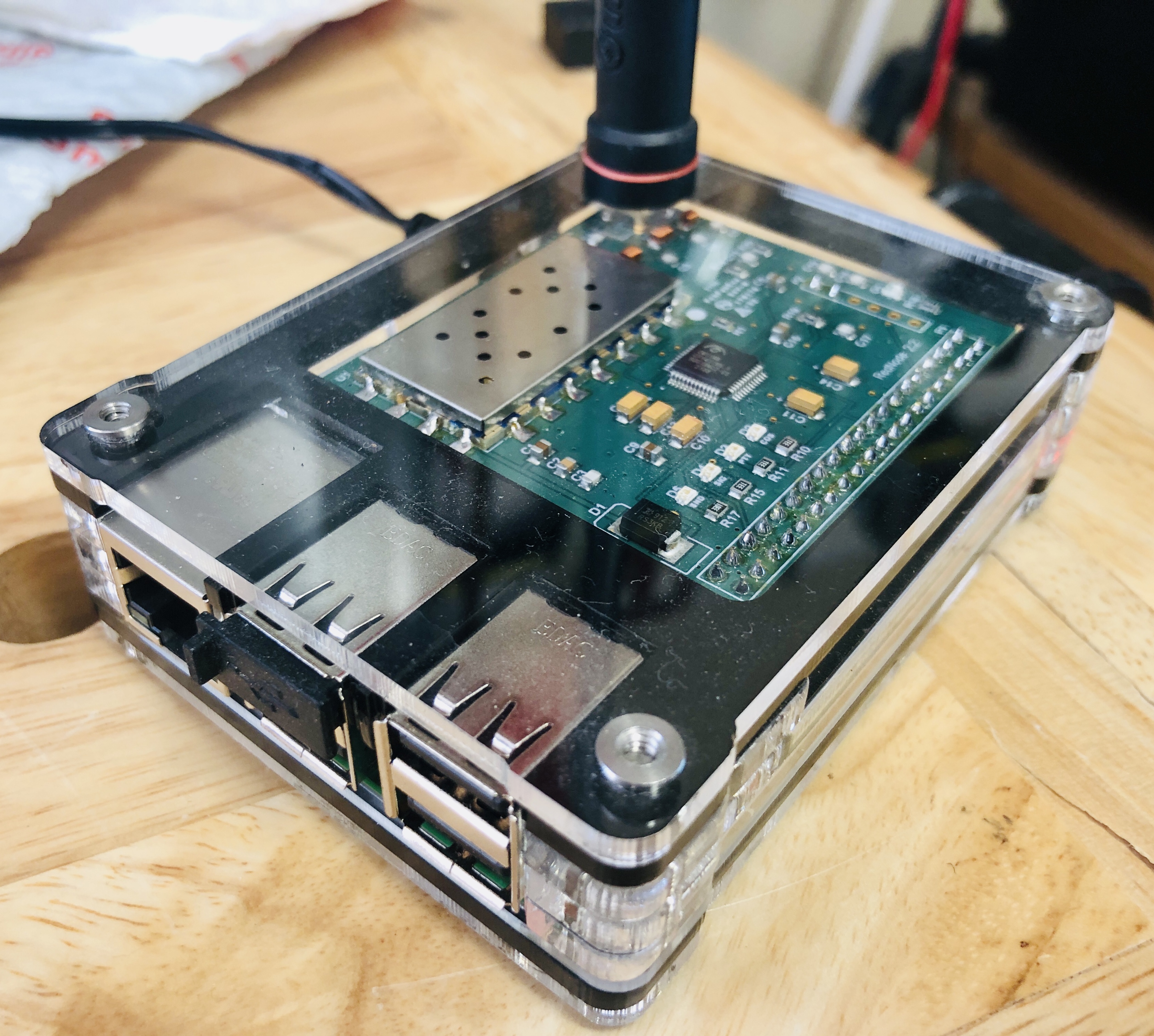
My ClearNode went on the air one year ago (March 2022).  Over the last twelve months, the ClearNode has been a real pleasure to use.

NJ2X's ClearNode

I have thoroughly enjoyed connecting to AllStarLink, EchoLink, DMR enabled repeaters and nodes all around the world to monitor and make contacts.  Exploring other internet-enabled repeaters has helped me discover some wonderful repeater systems and nets.

I have also enjoyed being able to connect to repeaters covering backcountry locations here in California and talking with ham friends while they were camping with their HTs.  This worked remarkably well and was fun amateur radio activity.

ClearNode

My ClearNode has become an excellent DXing tool.  I am a US County hunter and I have found that connecting to nodes in target Counties and dropping my call is a great way to meet hams in those Counties and arrange skeds.  This has been a game changer in my US County hunting.

Pros
  • The ClearNode works really well
  • Gerry's support is just wonderful (a big THANK YOU to Gerry)
  • Nice iPhone app makes it easy to connect to AllStar Link and EchoLink nodes
  • Great DXing tool
  • Looks great in the shack
  • More amateur radio fun!
  • Allstar Link, EchoLink, and DMR enabled repeaters are a blast to use
Cons
  • Can't think of any cons

There are a couple more digital voice modes that the ClearNode supports that I haven't dived into yet such as P25, YSFN (Fusion), FCS (Fusion), and NXDN.  I am glad the ClearNode supports all these extended capabilities since it provides additional learning opportunities to explore down the road.

I am so glad I took the leap in 2022 and bought a ClearNode.  I regret that I didn't do it sooner since it has helped me expand my amateur radio horizons and have even more fun.

Thank you to Gerry and Node-Ventures for making a great product and standing behind it with outstanding support.  Kudos!


Good DX and 73, NJ2X


Be sure to check out my other ClearNode related articles on NJ2X.com.


March 10, 2023

Completed 17m ARRL DXCC Award

A big THANK YOU to Joel, ZF2RJ in the Cayman Islands for being my 100th DXCC confirmed contact on 17 Meters on LoTW.  I am delighted to have earned the ARRL 17m DXCC award.  It took many years to earn this award.  Feeling happy having completed it at last.


Flag of the Cayman Islands

As I write this, I have now completed DXCC on 10 Meters, 15 Meters, 17 Meters, and 20 Meters.  I am working on achieving DXCC on several bands.
  • 12 Meters - Haven't had a 12m antenna for many years.  Going to be installing one soon.
  • 30 Meters - Making good progress (92 qualifying contacts confirmed on LoTW)
  • 40 Meters - Making good progress (87 qualifying contacts confirmed on LoTW)
  • 80 Meters - Slow progress (38 qualifying contact confirmed on LoTW)
  • 160 Meters - No antenna.
I am also pursuing the DXCC Challenge Award which requires confirming at least 1,000 DXCC band-points on any Amateur bands, 160 through 6 meters (except 60 meters).  I presently have 696 contacts confirmed on LoTW toward the DXCC Challenge Award.

Good DX and 73, NJ2X